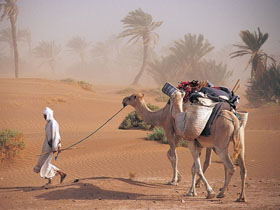
The Moroccan pre-Sahara begins as soon as you cross the Atlas to the south

Extreme Adventure Itinerary

The extreme trips are about exploring new ground in the quest to find a ider variety and more interesting routes. The approach here is that real adventure is about facing unknowns. Sometimes the trip will not go according to plan and often time will be lost due to backtracking from deadend pilot routes. The itinerary therefore needs to remain flexible and the group will have to work together as a team with each member playing their part. Days will be long, camping on route will be the favoured mode of accommodation to maintain flexibilty, and there is the possibility the group will have to face up to unforeseen challenges.


 There will be some hotels along the way at key points and time to stop and relax, but this is a more hardcore adventure for the experienced rider who wants to be involved with pioneering a new route over untested ground. Ultimately there should be a sense of acheivement from all the ground covered riding in challenging conditions.


Enduro Adventure Itinerary

The Eduro Adventure Itinerary is designed for riders with good experience riding off-road and wanting to cover on average of about 200km per day at a steady pace. Full days moving across different landscapes, with some nights camping.

Day 1 – Saturday

Arrive at hotel...
Introductions and brief safety talk

Day 2 - Sunday

150-200km route in and around the Erg Chebbi dunes to get to know the quads and re-familiarise riders with the variety of different terrains they will be facing in the coming week’s tour. Lunch-time stop at the Meski Oasis.

Day 3 - Monday
175-200km route along stoney and sandy pistes towards Zagora, travelling along the border with Algeria in places, where the group will pass several military outposts, hill forts and Berber villages and encampments. The group will need to cross several chotts, (dried river bed or lake) and there is a 10km meteor crater to cross also. The scenery is spectacular and the group will stop to camp that night.

Day 4 - Tuesday
150-200km route from night camp leaving early to make good time so the group can spend the afternoon relaxing by the pool at the hotel in Zagora. The pistes are fast taking the group through the only col (pass), a gateway from the Sahara to the lush oasis of the Draa valley. Zagora is the last major town before crossing the desert to Mauritania.


Day 5 - Wednesday
200km route from Zagora to Mhamid crossing the dunes at Iriki. Navigation is key to avoid the softer sections of sand as the dunes are constantly shifting. The final 10km is a dusty chott that leads into the palm groves of Mhamid where the group will make camp. This is a long and demanding day and depending on progress of the group there is a chance of making camp in the dark.

Day 6 – Thursday
There are 2 routes from night camp to stay in the evening with Berber tribesmen in their tents depending on how riders are fairing. A 175km easier southern route or a 250km route heading north back through the pass from the Sahara to Zagora. The first 100km of the northern route is along rugged mountain tracks and passes, later leading to sandy pistes. If the northern route is taken, it will be an early start and another tough day’s riding.

Day 7 – Friday
175km route back to Merzouga that should ensure an early arrival at the hotel to relax by the pool or do some shopping. Mostly fast sandy pistes with a large chott to cross, covering some of the same sections as day 2.

Day 8 – Saturday
Departure from hotel...

First Adventure Itinerary

he First Adventure Itinerary is designed for riders with a moderate or limited experience who have not ridden in Morocco. It allows the rider to build a wide experience of different conditions at a suitable pace without the pressure of long days and the need to cover big distances.
Day 1 - Saturday
Arrive at hotel
Day 2 - Sunday
Introduction to the quad bikes, safety equipment and general issues regarding safety
150km round trip to along well defined flat desert tracks to enable riders to get used to the terrain and their equipment. Mid-morning stop at deserted mud village and lunch-time break in the palm groves outside Rissani. Afternoon ride back to hotel, on terrain depending on the progress of the riders
Day 3 - Monday
180km round trip around the Erg Chebbi dunes with a lunch-time stop at Meski Oasis. Riders will experience soft sand conditions and the group will need to navigate around the drifting sand from the dunes. The route passes through a dry river bed where conditions can be equally demanding. Soft clay dust and sand masked by a hard clay crust, or soft mud depending on seasonal changes
Day 4 - Tuesday
150km route to night camp in Bedouin tents with local tribesmen. The ride will build on the experience gained so far.
Day 5 - Wednesday
150km route returning to the hotel closeby the Algerian border
Day 6 - Thursday
Optional rest day for those wanting to take a break from riding with a visit to the souks at Rissani on market day. There will be a lunch organised and the opportunity to shop and browse Moroccan carpets, jewellery and other handicraft.
For others wanting to continue to ride, the consensus will determine a route for this smaller group
Day 7 - Friday
Riding in the Erg Chebbi dunes, rising before dawn to take advantage or the harder sand conditions. The group will ride into the dunes and learn about navigating a course across this extreme landscape, returning to the hotel for lunch. Those wishing to explore the dunes further can opt to go on an evening trip after the heat of the day.
Day 8 - Saturday
Departure
Photo: quad bike atop a desert sand dune

Photo: quad riding in Morocco

Photo: greeted by local children
 

Trips and Itineraries


 Morocco Winter Trips
October to May avoids the intense heat of the deserts south of the Atlas mountains. Here you will find huge baron landscapes punctuated with oases and fertile palm valleys where nomadic tribesmen have traded for centuries. A unique experience which is different to anything else you will encounter, big long tracks and mountainous sandy dunes.


Morocco Summer and Winter Trips are 6 days riding with collections from Alicante and Almeria, Spain, group collections can be arranged from Marrakech.

Geotag Icon Spotlight: all about argan

                              
Throughout this journey, we will be documenting people, projects and ideas that we find inspiring – whether they relate to climate change, agriculture, rural transport, cooperative projects, human rights or humanitarian welfare (or anything else that interests us!) – in a series called “spotlight”. Here’s the first: on the argan tree, the women’s cooperatives who extract oil from it, and the tree’s importance in preventing desertification. If you like, you can listen to some audio we recorded in one of the cooperatives (”The merry nutcrackers“) as you read:


Towards the south of Morocco, away from the irrigated farmland of the north and its crops of potatoes, sugar cane, cereals, tomatoes, strawberries and field scale vegetables, we entered an area dominated by cereal production and extensive livestock farming (sheep, cattle and goats). Here, we regularly passed farmers carrying milk churns balanced between their legs as they drove their little Peugeot scooters to the local dairy co-operative. Threshing machines chugged away next to big stacks of cereals, which were transported there by tractor, donkey or camel.


Argan trees © Listen to Africa

Still further south, the mixed livestock gave way to goats, who are able to survive on the scrubby shrubs and trees found in this arid region. We spent many hours in the shade of thorny trees, sitting out the heat of the day, listening to larks singing away and watching goats climb the trees to reach their fruits. Having more than a passing interest in most (all!) things agricultural and natural, we set about finding out more about the trees. All the trees and bushes were the same species and, not recognising them, the first thing to find out was what they were. The first person we asked told us they were argan trees, and he went on to explain that oil is extracted from the seed by women, and is used for cooking, cosmetics and pharmaceuticals.

The argan tree (Argania spinosa) is a slow growing, spiny tree or shrub (growing up to 7-10 metres) endemic to south-western Morocco where it grows over an area of about 320,000 square miles.

As well as producing oil, the trees themselves provide forage for animals (the climbing goats) and fire wood for local communities. The waste pulp from the extraction process makes a highly palatable animal feed. It’s very much a multi use tree, and it plays an important part in the local economy, providing a much needed income for rural households.


Goats grazing under argan trees. © Listen to Africa

Its roots consolidate the soil and its canopy provides shade for other plants and crops, helping to maintain soil fertility and structure, and reducing soil erosion by wind and (infrequent but heavy) rainfall. As such, it’s important in the battle against desertification and, to a certain degree, in mitigating the effects of climate change. The production of argan oil has been taking place for centuries on a small cottage industry scale and, traditionally, women have always done the processing – an extremely labour intensive job. Nowadays, oil production has largely moved from homesteads to women’s cooperatives, and this pooling of resources and cooperative investment is helping to create a thriving industry in the arid south-west of Morocco, making a significant contribution to the economy and living standards in the region. The highly marketable products are sold in upmarket retail outlets around the world.


Traditional method of extracting argan oil

Argan oil is extracted from the kernel of the fruits of the argan tree. This labour intensive process starts with the removal of the outer layer of the ripe fruit to extract the nut, either by hand or by feeding the fruit to goats and removing the undigested nut from the dung. The nuts are then cracked using a small rock as a hammer against a larger rock (anvil) to remove the oil-bearing kernel. The kernels are air dried in clay containers, lightly roasted, left to cool and then ground into a paste using a hand turned mill. This paste is mixed with water and hand squeezed to extract the emulsion. Due to the high water content, the oil doesn’t keep well, so it need to be pressed regularly and have salt added to preserve it. While this method is still used for home consumption, the inconsistency of the end product means that most commercial production is now carried out in cooperatives.

Cooperative method of extracting argan oil

With the pooling of resources and the ability to collectively invest, some of the production stages in cooperatives have been mechanised, allowing a greater output and a more consistent end product. This volume of production has allowed rural women to market their products nationally and globally, command higher prices and significantly increase their income. The following is an indicative example of the production in one of the cooperatives, but levels of mechanisation vary.

The removal of the outer fruit on the whole has been mechanised, so after harvesting, the manual work starts with the cracking of the nut. This is done in large rooms with sometimes dozens of women sitting on cushions, all with their own sacks of nuts in front of them, tapping away with a rock at an incredible speed to extract the kernels.

The room is filled with the sound of the rhythmic tapping and constant chatting, turning this lengthy part of the process from a solitary or small group task into communal and sociable work. At the end of the day each person has their kernels weighed and logged in a ledger. The women are free to work for as long or as little as they want or can, allowing them to fit the work around their other commitments.

After the kernels have been extracted, cooking grade oil is lightly roasted and then ground into a paste (most co-ops have mechanised this step). The paste is then mechanically pressed, meaning there is no need to add water and the purer oil produced is then filtered and bottled. Oil for cosmetic products is not roasted, but is pressed and filtered before being processed into the end products.

In recent decades, there has been a decline in argan trees, due partly to several years of lower than average rainfall and partly to population pressure, especially overgrazing by livestock and firewood collecting. But the population view the argan tree as a valuable resource worth protecting. Replanting programmes have now been introduced and, although initially these weren’t altogether successful (due to inappropriate management), they’re now improving. This, along with the increasing marketing of the oil and cosmetics as a high quality product in a world market, means the future looks promising for argan.

Morocco Travel Guide

   
The first reaction of most visitors to the flood of new impressions is to draw a long, deep breath and sigh; the odours of mint and blossom mingling with the acrid smell of the tanners' yard, the unearthly wail of the Muezzin and muleteers "balek! balek!", the subtle intricacies of an art that had reached its apogee and a daily rhythm that seems barely to have changed since the coming of islam.
For some, it begins with a glimpse of the cloud-veiled Rif, the first of three giant ranges that slice sideways across the mountain and culminate in the High Atlas, a wonderfully impressive barricade of snow-clad peaks that tower above a mystic city, dark ravines and hidden valleys. Beyond the oases of extraordinary fertility, planted with pomegranite and palm and the only bulwarks against the advances of the sterile desert. Here the air is luminous, the silence almost deafening and one understands instinctively the burning desire for purity which has fueled every Moroccan dynasty.

The Almohads, Merinids and Almoravids came from the dunes but their genius erupted further north in a spectacular flowering of mosques, minarets and palaces that is everyones vision of life in the Orient. The monuments of Fes and Marrakech defy heaven in their own opulence but, at the heart of even the most sumptuous, there is the modest, desert dream of a life of quiet contemplation passed amid ripening fruit and the gurgling of fountains.
For some, the countries main appeal lies in the quality of its beaches. Morocco has always been a crossroads, the place where the East collides with the West and Africa shakes hands with Europe across the narrow straits of Gibraltar. It also marks the merger of the Mediterranean with the Atlantic and this gives Morocco two strikingly different coasts.
You may like to combine a few days on one of the beaches together with exploring the kasbahs and oases of the pre-Sahara where the only waves are those shaped by the receding dunes. You could disappear into the medieval world of Morocco's ancient cities and souks or go skiing in Oukaimeden or trekking on foot or on horseback in the high Atlas or play golf on some of the finest courses in the world.
Moroccans are friendly, polite, competitive and intensely curious about the outside world. Islam is a thriving faith but Morocco's version is also extremely moderate, open minded and tolerant. You can go a long way into the heart of their culture just by feeling independent enough to accept their hospitality which pours forth from rich and poor alike whether in the city or the countryside. Such gestures of friendship are what transforms a good holiday into a great experience, for then you are no longer just visiting but really living.
The accommodation in Morocco ranges from the luxury Aman chain, through grand hotels, the traditional riads in the medinas of Marrakech, Fes, Essaouira, ... and boutique hotels, onto the ideosyncratic residences in the desert and the atlas mountains. The larger hotels and hotel chains also offer a wide range of facilities with good value.
Our staff know and have visited all the places and Hotels And Riads featured on this website


and we are probably the best qualified and most knowledgeable team to help you select the most suitable itinerary to match your personal interests and requirements. Most other holiday companies deal in the "masses" - we deal in individuals.
Morocco is an exciting country. We have no need to make idle promises and exaggerations. It is all there for you to experience, but we will help you create an itinerary that involves as little inconvenience as possible and steer you away from the places that may be of little or no interest to you.


Sahara, brief view

Sahara [Arab.,=desert], world's largest desert, c.3,500,000 sq mi (9,065,000 sq km), N Africa; the western part of a great arid zone that continues into SW Asia. Extending more than 3,000 mi (4,830 km), from the Atlantic Ocean to the Red Sea, the Sahara is bounded on the N by the Atlas Mts., steppelands, and the Mediterranean Sea; it stretches south c.1,200 mi (1,930 km) to the Sahel , a steppe in W and central Africa that forms its southern border. The desert includes most of Western Sahara, Mauritania, Algeria, Niger, Libya, and Egypt; the southern portions of Morocco and Tunisia; and the northern portions of Senegal, Mali, Chad, and Sudan. The E Sahara is usually divided into three regions—the Libyan Desert , which extends west from the Nile valley through W Egypt and E Libya; the Arabian Desert , or Eastern Desert, which lies between the Nile valley and the Red Sea in Egypt; and the Nubian Desert , which is in NE Sudan.


Regions of sand dunes (erg) occupy only about 15% of the Sahara; "stone deserts," consisting of plateaus of denuded rock (hammada) or areas of coarse gravel (reg), cover about 70% of the region; mountains, oases, and transition zones account for the remainder. Sparse vegetation is found in most parts of the Sahara, with the exception of the sand dune regions. High mountain massifs rise in the central regions; they are the Ahagger (Hoggar) in S Algeria, which rises to more than 9,000 ft (2,740 m); the Tibesti Massif in N Chad, which rises to more than 11,000 ft (3,350 m); and the Aïr Mountains (Azbine) in N Niger, which rise to more than 6,000 ft (1,830 m). The mountains are deeply dissected and were in the past infamous for the shelter they provided to marauders preying on desert traffic. From west to east the four principal land routes across the desert are from Colomb-Bechar to Dakar; from Colomb-Bechar to Gao and Timbuktu by way of Reganne; from Touggourt to Agadez and Kano by way of In-Salah; and from Tripoli to Ghat.

Climate

The Sahara has one of the harshest climates in the world. Located in the trade winds belt, the region is subject to winds that are frequently strong and that blow constantly from the northeast between a subtropical high-pressure cell and an equatorial low-pressure cell. As air moves downward from the high-pressure into the low-pressure cell, it becomes warmer and drier. The desiccating and dust-laden winds are sometimes felt north and south of the desert, where they are variously known as sirocco, khamsin, simoom, and harmattan. The northern slopes of the Atlas Mts. intercept most of the moisture from winds blowing inshore from the Mediterranean Sea.

Border zones on the north and south, where the desert merges with the steppe, receive about 10 in. (25 cm) of rain a year with some seasonal regularity, but over most of the region rainfall is sparser, with an average annual total of less than 5 in. (12.7 cm); rainfall is usually torrential when it occurs after long dry periods that sometimes last for years. The region's low relative humidity rarely exceeds 30% and is often in the 4% to 5% range.

Daytime temperatures are high; Azizia, Libya, recorded the world's highest official temperature in the shade (136°F/58°C) in Sept., 1922. Heat loss is rapid at night and a diurnal range of 86°F (30°C) is common. Freezing temperatures are not uncommon at night from December to February.

Water and Other Resources

The Nile and Niger rivers, both fed by rains outside the desert, are the only permanent rivers in the region. Water is present at or just below the surface gravel in wadis (intermittent streams) that radiate from the mountain massifs, in scattered oases where the water table comes to the surface, and at greater depths in huge underground aquifers. The aquifers are believed to be filled with water dating from the Pleistocene epoch, when the Sahara was much wetter than it is today. The more than 20 lakes (called chotts in the north) and areas of salt flats and boggy salt marshes are also considered relics from this pluvial period.

Important discoveries of minerals, oil, and gas have been made in the Sahara. There are huge oil and gas deposits in Algeria and Libya, but in most cases, inaccessibility has delayed exploitation. In searching for oil reserves, underground deposits of water also have been found. Extensive iron ore deposits are worked in the Fort Gouraud area of Mauritania. Salt is still mined, as in the past, at Taoudenni, Mali, and at Bilma, Niger, and is transported, as in the days of the great medieval kingdoms of W Africa, by camel caravans across the desert.

People

Two thirds of the Sahara's estimated 2 million inhabitants (excluding those in the Nile valley) are concentrated in oases where date palms, fruits, vegetables, grains, and other crops are produced under irrigation. Nomads, with herds of sheep and goats and with camels for transportation, predominate in drier areas and continue to use oases (including modern oases created by the drilling of wells), as in centuries past, for water, trade, and provisioning stops. The principal ethnic groups of the Sahara are the Tuareg (of Berber origin), who dominate the mountains of the central Sahara; the peoples of mixed Berber and Arab origin in W Sahara; and the Tibu (Tébu), who dominate the Tibesti Massif.

History

The Sahara has undergone a series of wet periods, the most recent occurring c.5,000-10,000 years ago; it was not until c.3000 BC that the Sahara transformed into its present arid state. There is dispute as to whether the desertification of the region has continued into historic time. Those who support this theory contend that increasing aridity is the reason for the recorded advance of desert conditions into areas under cultivation in Roman times in the north and more recently (since the late 1960s) in the south. Opponents of this view explain such changes as being the result of alterations in land-use practices and neglect of water-supply and irrigation systems.

The camel was introduced probably in the 1st cent. AD and facilitated occupation by nomads (first the Berbers, later the Arabs), who lived in interdependence with the oasis dwellers, providing protection against enemies in exchange for supplies of food and water. A profitable trans-Saharan trade in gold and slaves from W Africa, salt from the desert, and cloth and other products from the cities on the Mediterranean coast was carried on by the nomads. The first European explorers to travel in the Sahara were Friedrich Horneman in 1805 and Mungo Park in 1806. Some areas of the Sahara remain virtually unexplored, although a network of air and automobile routes now crosses the desert and links the major oases and mining areas.

Bibliography

See C. Kruger et al., Sahara (tr. 1969); M. Williams and H. Faure, ed., The Sahara and the Nile: Quarternary Environments and Prehistoric Occupation in Northern Africa (1980); J. Cloudsley-Thompson, ed., Key Environments: Sahara Desert (1984); E. Gautier, Sahara (1987).